
UV Protection in the High Andes: What Your Pack Needs
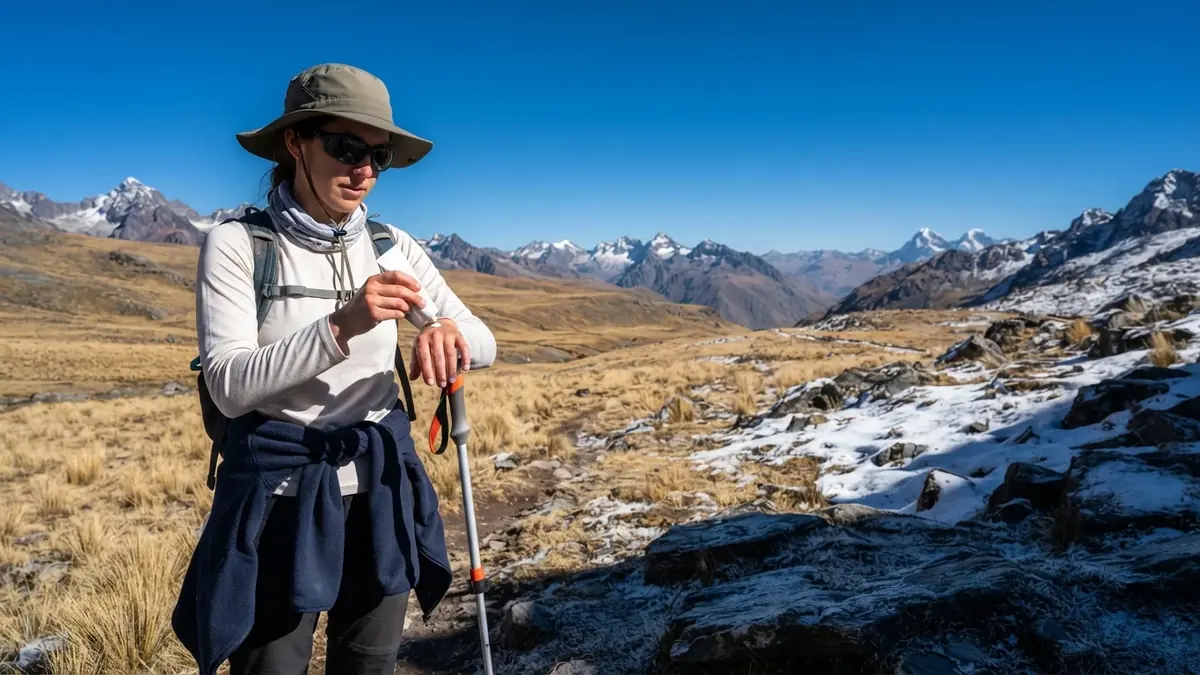
UV protection in the high Andes matters more than most first-time trekkers expect, because the WHO says UV levels rise by approximately 10 percent with every 1,000 meters of altitude. The same clear skies that make the sun strong also let the heat escape at night, so the high Andes ask for a sun kit and a warm layer in the same pack.
The seven answers below cover the sun, the snow, the cold and what to carry. Humantay Lake sits at about 4,200 meters and Rainbow Mountain at about 5,200, so even day hikes from Cusco put you well into this range.
How much stronger is the sun at altitude?
The WHO attributes the increase to thinner air that absorbs less UV. On its rule of thumb, a pass at 4,000 meters gets roughly 40 percent more UV than sea level under the same sky. SENAMHI reported UV index values of 16 to 17 in Cusco, which sits at about 3,350 meters, in November 2022. Its advice was a cap or hat, sunscreen and limiting sun exposure, and it said the readings had been running since October and could ease from the second half of November because rainfall was forecast below normal.
What do the UV index numbers mean?
The WHO recommends sun protection from an index of 3. Its messages come in three bands:
- 0 to 2: normally no protection is needed
- 3 to 7: seek shade during midday hours and wear a shirt, sunscreen and a hat
- 8 and above: avoid being outside during midday hours, seek shade, and treat shirt, sunscreen and hat as a must
The index reported each day is the maximum, reached during the four hours around solar noon. Cusco’s 2022 readings of 16 to 17 sit far above that last threshold.
Does cloud cover remove the risk?
Only thick cloud cover reduces exposure. The WHO says UV levels are highest under cloudless skies but can be high even with cloud cover, and that light or thin clouds have little effect and may even raise UV through scattering. It warns against underestimating the radiation that passes through clouds. A grey morning at 4,000 meters is a sunscreen morning too.
What does snow add?
Water and sand also raise the UV level, and fresh snow reflects it back at you. The WHO says it almost doubles a person’s exposure and that snow can reflect as much as 80% of UV radiation. On a snowy pass the radiation arrives from above and from below, which is why a hat brim and good sunglasses matter as much as sunscreen.
The Trekking in South America blog has posts on Andean treks, including day hikes to Humantay Lake, Laguna 69 and Rainbow Mountain, if you want routes to apply this to.
What does UV protection in the high Andes look like?
The WHO lists these measures:
- Seek shade whenever you can
- Wear protective clothing
- Wear a broad-brimmed hat to protect eyes, face, ears and neck
- Wear wraparound sunglasses with 99 to 100% UV-A and UV-B protection
- Use broad-spectrum sunscreen on skin that clothes cannot cover
It adds that protection works best through shade and clothing rather than sunscreen alone, and that sunscreen should not be used to extend time in the sun. Unprotected eyes can suffer photokeratitis, which is painful but reversible, and long-term exposure is linked to cataract.
When is the sun strongest, and when is the cold worst?
UV peaks in the four hours around solar noon, according to the WHO, and SENAMHI placed the highest intensity in Cusco between 11:00 and 15:00. The WHO adds that solar noon falls between noon and 2 p.m., depending on location.
Frost sits at the other end of the day: SENAMHI says it forms at night or before sunrise under clear skies. A route that starts early therefore meets cold first and strong sun later, which argues for a warm layer you can shed by mid-morning and a shaded rest at midday. In practice: leave at first light in the warm layer, take it off once the sun clears the ridge, and put the hat and sunglasses on before you need them.
How cold does it get on a clear night?
SENAMHI says frost affects the highlands above 3,000 meters, most often in the south, from April to September with a peak in June and July. In some southern areas the normal minimum is already below 0 °C. In NASA’s standard atmosphere model, air also cools about 6.5 °C for every 1,000 meters you climb, so a high camp is colder than the town you left. The model is an average, so real temperatures on a given route will vary. Expect to use the warm layer and the sun kit on the same day.